Finding yourself - and your roots - in the National Archives
Advertisement
Singapore
Finding yourself - and your roots - in the National Archives

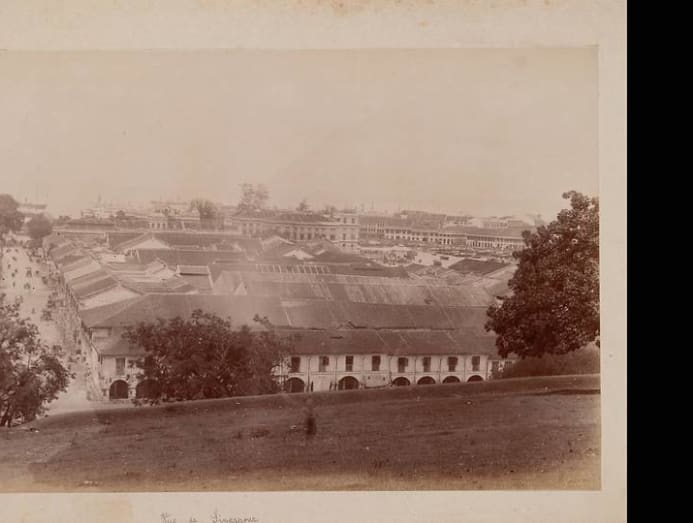
Ane of the primeval photographs of Singapore, dating from 1876, shows a Chinese tomb and h2o. Courtesy of National Athenaeum of Singapore

SINGAPORE: If you lot have ever been curious about your family history, consider taking a trip down to the National Athenaeum, tucked away in the heart of the urban center just beside the Registry of Marriages.
In that location, you tin sift through onetime wedlock records, schoolhouse records, and peradventure even find a mention of a relative or two in the prisoners-of-war records.
Friendly archivists, such every bit Ms Fiona Tan, 30, volition be more than happy to assist.
"I think two years ago, three years ago, in that location was a Masterchef Australia (participant) - Adam Liaw - he was down in Singapore for a filming for Destination Flavour," said Ms Tan.
"He wanted to endeavor to find out his family history because he had some ancestors who were based in Penang and Singapore. So the producers came to us and said that (they) found these things in the newspapers, is in that location anything more in the athenaeum?
"Some had to do with prisoners of war records. Considering we did acquire some of these overseas athenaeum prisoners-of-state of war records, we were able to help identify his great-grandfather'southward name in ane of the proper noun lists," she added.
READ: Ivory, rifles and opium: NLB'southward rare drove reveals Singapore'south 18th-century shopping list
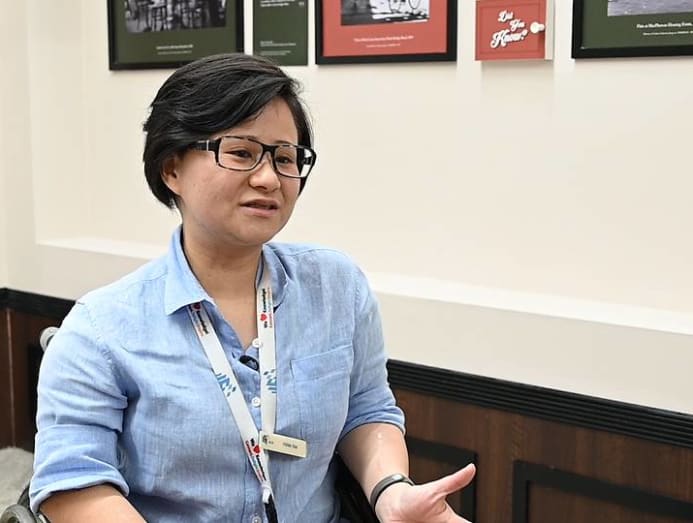
Wearing spectacles and a long-sleeved shirt rolled up to her elbows, Ms Tan looked every part the dedicated researcher.
"I'd like to say that the skill I do is to answer questions, which ways questions that comes from members of the public," said Ms Tan with a laugh.
And information technology is a job that she carries out with verve and passion. Taking CNA on a tour of the reference room, she explained what the room contains and the work of the archivists with a casual confidence.
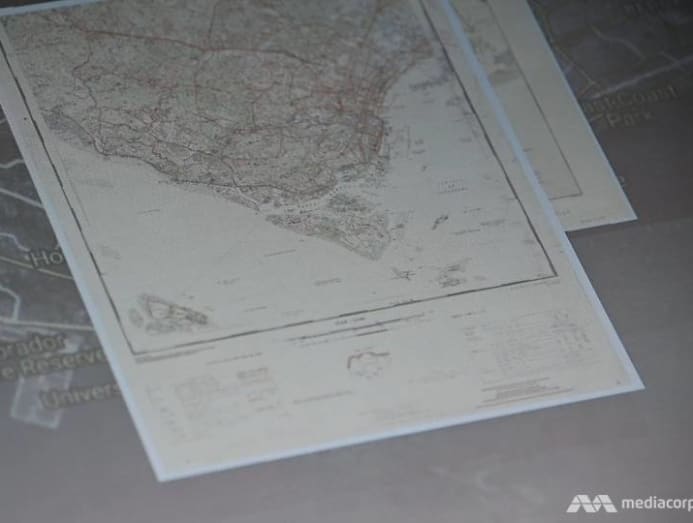
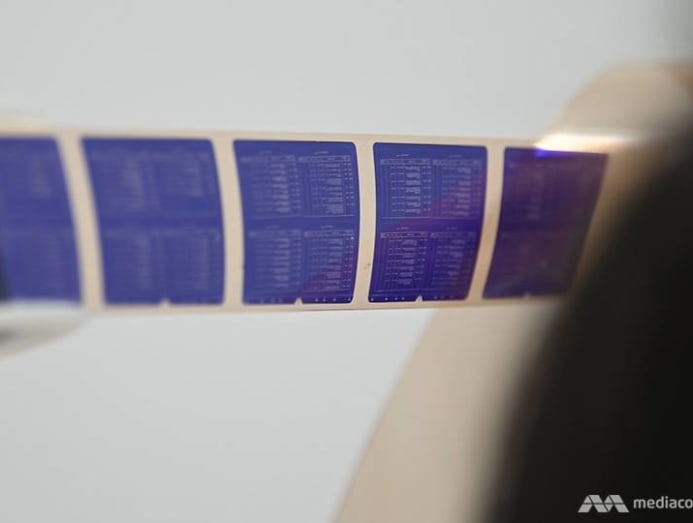
Non only tin visitors search existing records to trace their ancestry, they can likewise look at microfilms of erstwhile newspapers, notice some of the oldest photographs of Singapore and even superimpose older maps on superlative of current ones with the Archives' computers.
"It's always very rewarding to exist able to aid people find the data that they need," said Ms Tan.
"Sometimes information technology involves going downwards this rabbit hole whereby we're trying to discover new leads, the leads may not exist, or the archival sources may not even exist around, or it may non even take been created in the first place.
"But when we practise manage to help people find what they require, and so it's e'er very rewarding experience," she added.
FAMILY AND PERSONAL STORIES
According to Ms Tan, almost anything can be a source for family history research - even coroners' records.
"At that place was one example in which this person came in and she had a newspaper commodity that stated that one of her ancestors had died ... by his ain mitt, I remember that was what the newspaper article said," said Ms Tan.
"She was very curious as to why this ancestor decided to take his own life. So we were like, mayhap the coroners' records would have it, and indeed it did.
"It included the kinds of interviews that they had with his family, his colleague - then his concern was failing, and therefore he had depression."
While coroners' records are already well-known to academics and history students as a rich source of information, Ms Tan said she never expected these records to be useful to people looking for pieces of their family unit histories.
"Because it was an unnatural expiry (and) because he wasn't a colonial employee, so we wouldn't have any colonial accounts on him. He was just a business owner - and information technology wasn't a very prominent business, so nosotros were unlikely to have records.
"It was a scrap of trial and error."
Scout: iv Singaporeans search for answers virtually the by in the National Archives
But family history research is non the only reason why people might visit the athenaeum. Sometimes, she said, they await for old school records to apply for courses or employment.
"There was once this admirer who came in on Sabbatum morning," said Ms Tan. "I was alone – with another colleague who happened to be away doing something else. And then I was alone at the counter, and he came in to enquire to expect for his principal school records, merely he didn't call up what school he was studying at."
Ms Tan spent at to the lowest degree one hour with him, asking questions simply to triangulate the location of the school, including any landmarks that he would see walking to and from schoolhouse every twenty-four hours.
"He started to say that 'I will wake up at this time then I will attain school at half dozen.20am. And so it took me about xx minutes to (walk) to schoolhouse,'" she said.
"So okay, that's helpful. So information technology's within walkable altitude, yous're not travelling past a bus or anything. We had to call up old street directories, try to identify – and then finally we managed to notice that particular school location."
Information technology'due south a process of detective work, she explained, and it often means that she volition terminate up asking questions well-nigh even the colour of the user's schoolhouse uniform to slice together information about the particular schoolhouse.
"COULDN'T Do ENOUGH TO HELP"
But practice not be mistaken in thinking that each rabbit hole leads to a happy ending. Sometimes, the records can't be constitute simply because at that place were no records kept at all, or certain parts of the records are missing.
"There are certain cases whereby we may not be able to help them, just nosotros oftentimes do effort our best," said Ms Tan.
"I think there will always be those sorts of moments, whereby you feel that you couldn't do plenty to help a certain person to locate their information. But at the same time, information technology'south e'er useful to larn from the experience and then know what to await out for in the time to come."
She added that searching for data in the archives is non Google: "It's not a simple case of just typing in certain keywords or questions and you'll be able to get the answers immediately. In certain cases, you will take to go to page and pages of records."
Although archivists may not be able to assistance everyone seeking information, sometimes their efforts are all that's needed to make an impression.
"It'due south surprising how sometimes they would still remember us for the endeavour of helping - they will still come dorsum and thank u.s.a.," said Ms Tan.
She remembered one user who came in looking for schooling records for her night class, which the archives was unable to locate as the school did not keep track of students who studied office-time.
Even after budgeted the Found of Technical Education and the Ministry of Education, Ms Tan could still discover no trace of her education history.
"But she did manage to entreatment to become into that course of pick," said Ms Tan. "Then, 6 months later, when she was done with her starting time major test, she came back and she was similar 'Oh, I simply happened to be in the area, and just wanted to pop by to thank you.'
"So I idea that was very heartwarming that even though we weren't able to give her what she required, I think she appreciated the efforts we took to try to help her with it."
CONSERVING SINGAPORE'South RECORDS
All historical documents have to be conserved for future utilise. Inside a lab on the third floor of the building, conservators were hard at work preserving records kept in NAS'south repository.
Conservator Ong Fang Zheng, 30, was cheerful and enthusiastic when she greeted CNA at the door to the lab. She spoke with automobile-gun rapidity, explaining the various functions of the lab, from the rack of archival polyester used to protect old documents to the sleek white workbenches at the dorsum.

"You need to have skillful motor skills, good dexterity, that'southward for certain," she said. "A fine arts background would be helpful... A science background would be very helpful besides to understand the different kinds of… chemical reactions that we tin can take.
"And of course… having a real and keen involvement in the arts and heritage. Considering you tin can't really practise this work if you practice not take love for it."
Ms Ong's task is to preserve newspaper-based records: maps, books, edifice plans, posters and fifty-fifty photographs, doing both repair work and preventive care.
Documentation is the outset pace when conserving historical items. Ms Ong volition make note of the item's condition - what it is about and what needs repairing. Only subsequently writing this downwardly volition she brainstorm with surface cleaning, using a soft and delicate goat-hair brush to sweep away dirt.
To ensure that she is precise and careful with her piece of work, Ms Ong besides uses a microscope to become a closer view of the item - in this case, a map.
Whatsoever other repairs will be done based on the condition of the item.

"Maps are a scrap like prints. By prints we mean engraving, etching, wood cut. Ink is normally oil based, so you can launder it," said Ms Ong. Other items, like newspapers and photographs, demand to be treated with more care.
"Then that's when noesis is important," she said.
"WEIGHT OF THE RESPONSIBILITY"
Just no matter how experienced you are, in that location is always a inherent worry when handling the item, said Ms Ong.
"The virtually hard office of information technology is the weight of the responsibleness," she said. "Because I know that I'g working on something that is historical and cultural and it has lived on for centuries. And my job is to make certain information technology lasts for centuries more."
As much as it feels like an immense responsibility, the archives are very much deeply personal too.
"On the national level, the athenaeum is the custodian of official records. Simply of course, on the individual level, the archives is also a place whereby people can come to endeavour to find out their connectedness to other people," said Ms Tan.
"They can come hither to try to trace dorsum their roots, they can come here to try to empathize how life was different or how life was similar today."
Ms Ong added: "I retrieve this commodity I came beyond. It describes very aptly why nosotros need to save our culture.
"Because without our culture and our history, we have no identity. Without our identity, then who are nosotros?"

Recent Searches
Trending Topics
reeddreasockinly80.blogspot.com
Source: https://cnalifestyle.channelnewsasia.com/singapore/finding-yourself-and-your-roots-national-archives-228796

Post a Comment for "Finding yourself - and your roots - in the National Archives"