What Was the First Act Used by the British to Raise Revenue From the Colonies?
"...The English government cannot long act towards a part of its dominions diametrically opposed to its ain, without losing itself in the slavery it would impose upon the colonies."—New York Gazette, June 6, 1765, reprinted in Boston Evening Mail, June 24, 1765[ane]
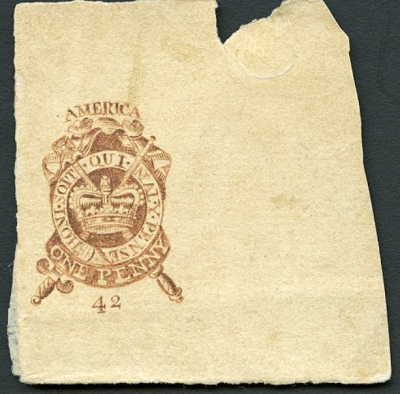
Smithsonian Establishment
Harbottle Dorr, a Due north Cease ironmonger [seller of hardware, tools, and household implements], began collecting and annotating Boston newspapers in January 1765. Offering his opinions as a human of middling rank toward the Revolutionary struggle for freedom, he claimed that the June 6 New York Gazette article "first gave the Alert about the Stamp Act."[2]
Parliament passed the Postage stamp Human activity on March 22, 1765, to pay down a national debt approaching £140,000,000 afterwards defeating France in the Seven Years War (1763). A twelvemonth before, Parliament passed the Sugar Act, their first acquirement-raising measure. Both taxes promised dire consequences in a post-state of war economy. While the Carbohydrate Act was a duty only on foreign goods, the Stamp Act taxed items within the colonies. Previously, only colonial assemblies causeless responsibility for internal taxes.[3]
Beginning November ane, 1765, legal documents, academic degrees, appointments to office, newspapers, pamphlets, playing cards, and die required embossing with a Treasury postage as proof of payment of the revenue enhancement.[four] Colonial essayists, orators, and ordinary people responded with cries of "slavery," "tyranny," and "No taxation without representation."

Archives and Collections at Amherst College
The same angry colonists who now attacked British taxation policies had proudly historic their state'southward victories in the Seven Years War a few years earlier. On October 16, 1759, Bostonians celebrated Britain's defeat of French republic in the Plains of Abraham battle in Quebec. Printer John Boyle noted: "…the Regiment of Militia were mustered, and the Town beautifully illuminated in the Evening." On September 26, 1760, "public rejoicing" accompanied news of Montreal'southward give up. Finally, on May 24, 1763, Boyle declared United kingdom of great britain and northern ireland'due south consummate victory: "The Definitive Treaty of Peace and Friendship betwixt the Male monarch of Peachy Britain, the French and Spanish Kings was sign'd at Paris February 10, 1763."[v]
Massachusetts remained peculiarly proud since thousands of her provincial soldiers served—and died—alongside British "regulars" in the New York and Canadian theaters of war. Among them was 21-year-old silversmith Paul Revere, who enlisted every bit a Second Lieutenant in Richard Gridley's Artillery Train on February eighteen, 1756. French victories cancelled Revere's participation in a British plan to seize a French fort at Crown Point on Lake Champlain, New York, and he returned habitation in November 1756.[6]

Nether the peace treaty Britain gained vast new territory, including French Canada and French territory east of the Mississippi. How would Britain pay downwards its war debt and the boosted expense of defending its enlarged Northward American empire? How would American colonists answer to Britain's policies?[seven]
Peace concluded colonial contracts to supply the British military with weapons, uniforms, and provisions as well as the steady supply of golden and silverish that paid for those goods. Later 1760, British merchants began tightening up credit to colonial merchants. Britain's slowing economic system led to a slumping West Indian economy, which reduced demand for New England livestock, lumber, and fish. Merchants in Boston, New York, and Philadelphia alleged bankruptcy in alarming numbers.[8]
Artisans and laborers faced lower income and college costs of food, firewood, and taxes.[9] On February 26, 1764, John Boyle wrote virtually some other crisis—smallpox: "…'tis feared by many that it will exist impractible [impractical] to forestall its spreading thro' the Town."[x] Paul Revere'due south family was i of seven afflicted families in Boston'south North End. Though his family survived, Revere'due south income from his previously thriving silver shop dropped from £102 in 1764 to £60 in 1765.[xi]
To make matters worse, Britain began imposing taxes, leading to more economic distress—and political danger. On May 15, 1764, the Boston Town Coming together asked their representatives to the Massachusetts General Court [Legislature] to
use your power and influence in maintaining the invaluable Rights and Privileges of the Province…For if our Merchandise may be taxed why not our Lands? Why not the produce of our Lands, and every Thing we possess or make use of?....If Taxes are laid upon us in whatever shape without ever having a Legal Representative where they are laid, are nosotros not reduced from the Grapheme of Free Subjects to the miserable state of tributary Slaves… [12]

Christ Church, University of Oxford
British officials saw the situation differently. When George Grenville became Prime Government minister in April 1763, he grappled with the national debt, a debt that included an annual estimated cost of £200,000 for 10,000 soldiers in America recommended by his predecessor Lord Bute. The outbreak of Pontiac's Rebellion, a major American Indian uprising in the Ohio country in May 1763, increased the urgency to maintain a military strength in America.[13]
During the war, Britons at home bore a heavy tax burden. In contrast, the Crown requisitioned colonial assemblies for soldiers and supplies but could not forcefulness compliance, and reimbursed as much every bit 2-fifths of the expenses. It seemed reasonable that the colonies should contribute to their own defense, especially since the Board of Trade estimated that the American colonies annually smuggled approximately £700,000 of merchandise. It also seemed logical to examine existing merchandise laws every bit a starting betoken for new taxes.[14]
In 1651 Britain passed its beginning Navigation Human action and connected to update trade acts as needed. However, the goal was non to raise revenue but to impose a loftier plenty duty on foreign trade to aqueduct trade between Britain and her colonies.[15] Grenville's proposed duties would raise revenue and be strictly enforced, reducing the colonists' ability to evade duties.
He began past revising the Molasses Act of 1733, due to elapse in December 1763. Enacted on Apr 5, 1764, to take effect on September 29, the new Sugar Human activity cut the duty on foreign molasses from 6 to 3 pence per gallon, retained a high duty on foreign refined sugar, and prohibited the importation of all foreign rum. This part of the act affected New England, where distilling carbohydrate and molasses into rum was a major industry.[xvi] The Saccharide Deed too taxed numerous foreign products, including wine, java, and textiles, and banned the direct shipment of several important commodities such every bit lumber to Europe, upsetting the balance of trade for merchants in Northern seaports. Passage of the Currency Act on April 19, 1764 (effective September i, 1764) banned colonial newspaper currency, requiring the Sugar Human action to be paid in gold and silverish.[17]
More than one-half of the manufactures in the Sugar Human activity dealt with enforcement. It required Customs collectors to report to their colonial posts, instead of appointing underlings who were susceptible to bribery. Masters of vessels had to post a bond and carry affidavits attesting to the legality of their cargo. At every stop in their voyage officials examined their paperwork, assisted in their efforts past the Royal Navy. Those caught with illegal cargo were no longer tried by a sympathetic local jury just at a new vice-admiralty courtroom in Halifax, Nova Scotia.[18]
On January xiv, 1765, the Boston Evening Post printed a letter from London, dated October twenty, 1764, about the new merchandise regulations: "….every cargo of the American production is deemed prohibited goods….if, therefore, this traffic is prohibited, the colonies must be ruined…."[19]
Their ruin was not consummate. In the summer of 1764, James Otis, Boston attorney and representative to the Massachusetts General Court, responded to the Sugar Act with The Rights of the British Colonies Asserted and Proved. After promising colonial obedience to King and Parliament, Otis emphatically upheld an essential right of all English language citizens: "Taxes are not to be laid on the people, but by their consent in person, or by deputation…." On February 8, 1765, Arthur Brutal, writing from London, informed his brother, merchant Samuel Phillips Savage, that the Stamp Act had passed "by a dandy majority." Otis's statement "has not been of whatsoever service."[20]
The struggle for liberty was just start.
Larn about Boston's reaction to the Postage stamp Act.
Contributed by: Jayne E. Triber, Park Guide
Footnotes
[1] In Harbottle Dorr Collection of Annotated Massachusetts Newspapers, 1765-1776, Vol. I, pp. 111, 114, https://www.masshist.org/dorr/.
[2] Jayne Due east. Triber, A True Republican: The Life of Paul Revere (Boston: University of Massachusetts Press, 1998), 41-42.
[3] Ed., Jack P. Greene, Colonies to Nation, 1763-1789: A Documentary History of the American Revolution (New York: Due west. W. Norton, 1975), 12-44; Edmund S. And Helen Chiliad. Morgan, The Postage stamp Act Crisis: Prologue to Revolution (New York and London: Collier Macmillan, 1963), Affiliate Five; I. R. Christie, Crisis of Empire: Swell Uk and the American Colonies, 1754-1783 (New York: Due west. Due west. Norton, 1966), Affiliate 3.
[iv] Text of Stamp Act: https://avalon.law.yale.edu/18th_century/stamp_act_1765.asp
[5] Boyle's Journal of Occurrences in Boston, 1759-1788, New England Historical and Genealogical Register Vol. 84 (April 1930), 148-149 (on Quebec and Montreal), 162 (on peace); Derek McKay and H. Grand. Scott, The Rise of the Great Powers, 1648-1815 (London and New York: Longman, 1983), 192-200; Christie, Crisis of Empire, Affiliate 2.
[6] Revere'due south reminiscences of military machine service, fragment, second copy, Apr 27, 1816, Roll iii, Revere Family Papers, Massachusetts Historical Society (MHS); Triber, A True Republican, 21-25; Fred Anderson, A People's Army: Massachusetts Soldiers and Club in the Seven Years' War (Chapel Hill and London: University of Northward Carolina Press, 1984), 1-12, 26-39, 168-180.
[7] McKay and Scott, The Rising of the Great Powers, pp. 197-200; Greene, Colonies to Nation, 12-14; Lawrence Henry Gipson, The Coming of the American Revolution, 1763-1775 (New York: Harper and Row, 1954), 55-57.
[8] Marc Egnal, A Mighty Empire: The Origins of the American Revolution (Ithaca and London: Cornell University Printing, 1988), 126-135; Gary B. Nash, The Urban Crucible: Social Change, Political Consciousness, and the Origins of the American Revolution (Cambridge and London: Harvard Academy Printing, 1979), 246-250.
[ix] Nash, Urban Crucible, 250-263.
[x] Boyle's Journal of Occurrences, 84, 164.
[eleven] On the smallpox epidemic, see Christian Di Spigna, Founding Martyr: The Life and Decease of Dr. Joseph Warren, the American Revolution'southward Lost Hero (New York: Broadway Books, 2018), 62-66. Revere's income, in Waste Volume and Memoranda, Vol. I, Gyre 5, Revere Family Papers, MHS. Run across also, Triber, A True Republican, 37-41.
[12] Ed., William H. Whitmore, Report of the Tape Commissioners of Boston, Boston Town Records, 1758-1769 (Boston: Rockwell and Churchill, 1886), 119-122 (quotes on p. 120, 121-122).
[13] Christie, Crunch of Empire, 39-46; John 50. Bullion, "Security and Economy: The Bute Assistants'south Plans for the American Army and Revenue, 1762-1763, William and Mary Quarterly, 3rd Ser., 45 (July 1988), 499-504.
[14] For at least 2 decades before Grenville'southward taxation programme, Board of Trade records document colonial smuggling. Run across Christie, Crisis of Empire, 31-32, 39-46; Gipson, Coming of the American Revolution, 55-59; Thomas C. Barrow, "Background to the Grenville Program, 1757-1763," William and Mary Quarterly, Five. 22, No. ane (Jan. 1965), 93-104 (p. 95 on 1759 trade investigation); Don Cook, The Long Fuse: How England Lost the American Colonies, 1760-1785 (New York: Atlantic Monthly Printing, 1995), 58.
[15] Gipson, Coming of the American Revolution, 22-27.
[16] Christie, Crisis of Empire, 46-48; Gipson, Coming of the American Revolution, 55-59. On the role of rum in the New England slave trade, see Jared Hardesty, Black Lives, Native Lands, White Worlds: A History of Slavery in New England (Amherst and Boston: Academy of Massachusetts Printing, 2019), 26-28, and "The Slave Merchandise," Massachusetts Historical Society (MHS), African Americans and the End of Slavery.
[17] For full text of the Sugar Deed, see https://avalon.law.yale.edu/18th_century/sugar_act_1764.asp. For more on the Sugar and Currency Acts, see Greene, Colonies to Nation,12-16, 25-26; Christie, Crisis of Empire, 46-48; Morgan and Morgan, The Stamp Human action Crisis, Chapter 3.
[eighteen] Text of Saccharide Act, relating to enforcement, starting with Article XX, in https://avalon.police force.yale.edu/18th_century/sugar_act_1764.asp. Run across likewise, Greene, Colonies to Nation, 12-xvi; Christie, Crisis of Empire, 48-49; Morgan and Morgan, The Stamp Human action Crisis, 39-41.
[nineteen] Harbottle Dorr Collection, Vol. I, p.five, https://world wide web.masshist.org/dorr/.
[20] Otis, The Rights of the British Colonies Asserted and Proved, in Greene, Colonies to Nation, 28-33; Arthur Savage, Jr., to Samuel Phillips Savage, February 8, 1765, Due south. P. Cruel II Papers, MHS; Triber, A True Republican, 39-xl.
reeddreasockinly80.blogspot.com
Source: https://www.nps.gov/articles/000/sugar-and-stamp-acts.htm

Post a Comment for "What Was the First Act Used by the British to Raise Revenue From the Colonies?"