Can a Hearing Aid Help Understand Words Again
What is a hearing aid?
A hearing aid is a modest electronic device that you wear in or backside your ear. It makes some sounds louder so that a person with hearing loss can heed, communicate, and participate more than fully in daily activities. A hearing aid can help people hear more in both serenity and noisy situations. Withal, merely near 1 out of five people who would benefit from a hearing help really uses one.
A hearing assist has three bones parts: a microphone, amplifier, and speaker. The hearing aid receives sound through a microphone, which converts the sound waves to electrical signals and sends them to an amplifier. The amplifier increases the power of the signals and then sends them to the ear through a speaker.
How can hearing aids help?
Hearing aids are primarily useful in improving the hearing and speech comprehension of people who accept hearing loss that results from harm to the small sensory cells in the inner ear, called hair cells. This type of hearing loss is called sensorineural hearing loss. The damage tin occur equally a consequence of affliction, aging, or injury from racket or sure medicines.
A hearing aid magnifies sound vibrations entering the ear. Surviving hair cells detect the larger vibrations and convert them into neural signals that are passed along to the brain. The greater the damage to a person's pilus cells, the more severe the hearing loss, and the greater the hearing aid amplification needed to make up the divergence. Still, in that location are applied limits to the corporeality of amplification a hearing aid can provide. In addition, if the inner ear is besides damaged, fifty-fifty large vibrations will not be converted into neural signals. In this state of affairs, a hearing aid would be ineffective.
How can I find out if I need a hearing assist?
If you recollect you might have hearing loss and could benefit from a hearing assist, visit your doctor, who may refer you lot to an otolaryngologist or audiologist. An otolaryngologist is a md who specializes in ear, nose, and pharynx disorders and will investigate the crusade of the hearing loss. An audiologist is a hearing health professional who identifies and measures hearing loss and volition perform a hearing test to appraise the type and degree of loss.
Are at that place different styles of hearing aids?
Styles of hearing aids
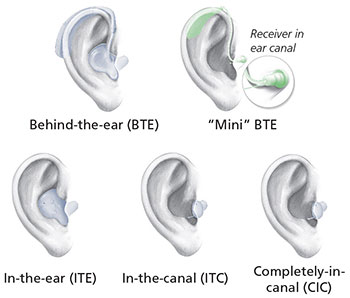
Source: NIH/NIDCD
-
Behind-the-ear (BTE) hearing aids consist of a hard plastic case worn behind the ear and connected to a plastic earmold that fits within the outer ear. The electronic parts are held in the example behind the ear. Sound travels from the hearing aid through the earmold and into the ear. BTE aids are used by people of all ages for mild to profound hearing loss.
A new kind of BTE assistance is an open-fit hearing help. Small, open-fit aids fit behind the ear completely, with only a narrow tube inserted into the ear canal, enabling the canal to remain open. For this reason, open-fit hearing aids may be a skillful choice for people who experience a buildup of earwax, since this type of assistance is less likely to be damaged past such substances. In add-on, some people may prefer the open-fit hearing assistance because their perception of their voice does not sound "plugged up."
-
In-the-ear (ITE) hearing aids fit completely inside the outer ear and are used for mild to severe hearing loss. The case holding the electronic components is made of hard plastic. Some ITE aids may take sure added features installed, such equally a telecoil. A telecoil is a small magnetic roll that allows users to receive sound through the circuitry of the hearing aid, rather than through its microphone. This makes information technology easier to hear conversations over the telephone. A telecoil also helps people hear in public facilities that accept installed special audio systems, called induction loop systems. Induction loop systems can be found in many churches, schools, airports, and auditoriums. ITE aids usually are not worn by young children because the casings need to be replaced oftentimes as the ear grows.
-
Canal aids fit into the ear culvert and are available in two styles. The in-the-culvert (ITC) hearing aid is made to fit the size and shape of a person's ear culvert. A completely-in-canal (CIC) hearing aid is near hidden in the ear canal. Both types are used for balmy to moderately astringent hearing loss.
Considering they are small, canal aids may be difficult for a person to adjust and remove. In addition, canal aids have less space available for batteries and additional devices, such every bit a telecoil. They ordinarily are non recommended for young children or for people with astringent to profound hearing loss considering their reduced size limits their power and volume.
Do all hearing aids work the same manner?
Hearing aids work differently depending on the electronics used. The two chief types of electronics are analog and digital.
Analog aids convert sound waves into electrical signals, which are amplified. Analog/adaptable hearing aids are custom congenital to meet the needs of each user. The aid is programmed by the manufacturer co-ordinate to the specifications recommended by your audiologist. Analog/programmable hearing aids have more than one plan or setting. An audiologist can programme the assist using a computer, and you can alter the program for different listening environments—from a pocket-size, quiet room to a crowded restaurant to large, open areas, such as a theater or stadium. Analog/programmable circuitry tin can be used in all types of hearing aids. Analog aids usually are less expensive than digital aids.
Digital aids catechumen sound waves into numerical codes, like to the binary code of a figurer, earlier amplifying them. Because the code besides includes information about a audio's pitch or loudness, the assistance tin be specially programmed to dilate some frequencies more others. Digital circuitry gives an audiologist more than flexibility in adjusting the aid to a user's needs and to sure listening environments. These aids also can be programmed to focus on sounds coming from a specific direction. Digital circuitry can exist used in all types of hearing aids.
Which hearing aid volition piece of work best for me?
The hearing aid that volition work best for you depends on the kind and severity of your hearing loss. If you have a hearing loss in both of your ears, two hearing aids are more often than not recommended because ii aids provide a more natural point to the brain. Hearing in both ears also will assistance you understand voice communication and locate where the sound is coming from.
Yous and your audiologist should select a hearing aid that best suits your needs and lifestyle. Toll is also a primal consideration considering hearing aids range from hundreds to several thou dollars. Similar to other equipment purchases, style and features affect cost. Nonetheless, don't use price solitary to determine the all-time hearing aid for you. But considering one hearing aid is more than expensive than another does non necessarily mean that it will amend accommodate your needs.
A hearing help will not restore your normal hearing. With practice, still, a hearing help will increase your awareness of sounds and their sources. You volition desire to wear your hearing assist regularly, and then select ane that is user-friendly and easy for you lot to use. Other features to consider include parts or services covered past the warranty, estimated schedule and costs for maintenance and repair, options and upgrade opportunities, and the hearing aid company'due south reputation for quality and client service.
What questions should I ask before ownership a hearing aid?
Earlier you lot buy a hearing aid, ask your audiologist these important questions:
- What features would be nearly useful to me?
- What is the total toll of the hearing aid? Do the benefits of newer technologies outweigh the higher costs?
- Is at that place a trial period to examination the hearing aids? (Well-nigh manufacturers allow a 30- to 60-day trial menstruum during which aids tin can exist returned for a refund.) What fees are nonrefundable if the aids are returned later on the trial period?
- How long is the warranty? Can it be extended? Does the warranty embrace futurity maintenance and repairs?
- Can the audiologist make adjustments and provide servicing and minor repairs? Volition loaner aids exist provided when repairs are needed?
- What instruction does the audiologist provide?
How tin can I adapt to my hearing assist?
Hearing aids take fourth dimension and patience to utilize successfully. Wearing your aids regularly will help you adjust to them.
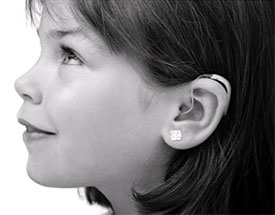
Go familiar with your hearing aid'south features. With your audiologist nowadays, exercise putting in and taking out the aid, cleaning it, identifying right and left aids, and replacing the batteries. Ask how to test it in listening environments where you lot have problems with hearing. Learn to adjust the aid's volume and to programme it for sounds that are too loud or as well soft. Work with your audiologist until y'all are comfortable and satisfied.
You may experience some of the following issues as you lot arrange to wearing your new aid.
- My hearing help feels uncomfortable. Some individuals may observe a hearing aid to be slightly uncomfortable at first. Ask your audiologist how long you should wear your hearing aid while yous are adjusting to it.
- My phonation sounds too loud.The "plugged-upwardly" sensation that causes a hearing aid user's voice to audio louder within the head is called the apoplexy result, and it is very common for new hearing aid users. Cheque with your audiologist to see if a correction is possible. Nigh individuals get used to this result over fourth dimension.
- I go feedback from my hearing aid. A whistling audio can be caused by a hearing aid that does not fit or piece of work well or is clogged by earwax or fluid. See your audiologist for adjustments.
- I hear background noise.A hearing aid does non completely separate the sounds you lot want to hear from the ones yous practise not want to hear. Sometimes, however, the hearing aid may need to be adjusted. Talk with your audiologist.
- I hear a buzzing sound when I use my prison cell telephone.Some people who wearable hearing aids or accept implanted hearing devices feel problems with the radio frequency interference caused by digital cell phones. Both hearing aids and prison cell phones are improving, nevertheless, so these problems are occurring less oftentimes. When y'all are being fitted for a new hearing assistance, take your cell telephone with you to see if it will piece of work well with the assist.
How can I care for my hearing aid?
Proper maintenance and care will extend the life of your hearing aid. Make information technology a habit to:
- Keep hearing aids away from rut and moisture.
- Make clean hearing aids as instructed. Earwax and ear drainage tin can damage a hearing assistance.
- Avoid using hairspray or other hair care products while wearing hearing aids.
- Turn off hearing aids when they are non in use.
- Replace dead batteries immediately.
- Keep replacement batteries and small aids abroad from children and pets.
Are new types of aids available?
Although they work differently than the hearing aids described to a higher place, implantable hearing aids are designed to help increase the transmission of sound vibrations entering the inner ear. A middle ear implant (MEI) is a small device attached to i of the basic of the heart ear. Rather than amplifying the sound traveling to the eardrum, an MEI moves these bones directly. Both techniques take the cyberspace result of strengthening sound vibrations entering the inner ear so that they can be detected by individuals with sensorineural hearing loss.
A bone-anchored hearing aid (BAHA) is a minor device that attaches to the os behind the ear. The device transmits sound vibrations directly to the inner ear through the skull, bypassing the middle ear. BAHAs are generally used by individuals with centre ear issues or deafness in ane ear. Considering surgery is required to implant either of these devices, many hearing specialists feel that the benefits may non outweigh the risks.
Can I obtain financial help for a hearing aid?
Hearing aids are by and large not covered past health insurance companies, although some do. For eligible children and young adults ages 21 and under, Medicaid will pay for the diagnosis and treatment of hearing loss, including hearing aids, under the Early and Periodic Screening, Diagnostic, and Treatment (EPSDT) service. Also, children may exist covered by their state'due south early intervention plan or State Children's Health Insurance Program.
Medicare does not comprehend hearing aids for adults; all the same, diagnostic evaluations are covered if they are ordered by a md for the purpose of assisting the md in developing a treatment program. Since Medicare has alleged the BAHA a prosthetic device and not a hearing assist, Medicare will cover the BAHA if other coverage policies are met.
Some nonprofit organizations provide fiscal help for hearing aids, while others may help provide used or refurbished aids. Contact the National Institute on Deafness and Other Communication Disorders (NIDCD) Information Clearinghouse with questions well-nigh organizations that offer financial assist for hearing aids.
What enquiry is being washed on hearing aids?
Researchers are looking at ways to apply new indicate processing strategies to the design of hearing aids. Point processing is the method used to modify normal sound waves into amplified audio that is the best possible match to the remaining hearing for a hearing aid user. NIDCD-funded researchers also are studying how hearing aids can enhance speech signals to improve understanding.
In add-on, researchers are investigating the use of computer-aided technology to design and manufacture better hearing aids. Researchers also are seeking ways to improve sound manual and to reduce racket interference, feedback, and the occlusion effect. Additional studies focus on the all-time means to select and fit hearing aids in children and other groups whose hearing power is hard to test.
Another promising enquiry focus is to employ lessons learned from animal models to blueprint ameliorate microphones for hearing aids. NIDCD-supported scientists are studying the tiny flyOrmia ochracea considering its ear construction allows the fly to determine the source of a sound easily. Scientists are using the fly's ear structure every bit a model for designing miniature directional microphones for hearing aids. These microphones dilate the sound coming from a particular direction (usually the direction a person is facing), but not the sounds that make it from other directions. Directional microphones hold great hope for making it easier for people to hear a single conversation, even when surrounded by other noises and voices.
Where tin I find additional information about hearing aids?
The NIDCD maintains a directory of organizations that provide data on the normal and disordered processes of hearing, remainder, taste, smell, vocalisation, voice communication, and language.
Employ the following keywords to help you find organizations that can respond questions and provide information on hearing aids:
- Hearing aids
- Assistive listening device
- Assistive technology
NIDCD Information Clearinghouse
1 Communication Avenue
Bethesda, Dr. 20892-3456
Price-free vocalism: (800) 241-1044
Toll-gratis TTY: (800) 241-1055
Email: nidcdinfo@nidcd.nih.gov
NIH Pub. No. 13-4340
Updated September 2013
reeddreasockinly80.blogspot.com
Source: https://www.nidcd.nih.gov/health/hearing-aids

Post a Comment for "Can a Hearing Aid Help Understand Words Again"